


Automatic Swing Doors

Overhead Automatic Swing Door
By far the most common automatic door in the UK, automatic swing doors outsell auto sliding doors 5 to 1. Installed above the door on the transom, this versatile door can be installed to aluminium, glass, wood and even PVC Doors. Available in a pushing or pulling configuration.
Types:
Fully Automatic Door – The door will open automatically, you approach from either side by way of sensor activation.
Semi Automatic Door – This door will open upon an activation from a Press pad or touch-less button.
Low Energy Automatic Door – A swing door with no safety sensors. It works terribly slow to reduce the risk of collision forces. Not common in the UK any more since the introduction of the BS EN16005:2012.
Security Automatic Door – Will only unlock and open upon an activation from a secure source such as an access control card, proximity fob, mobile phone or internal reception button.
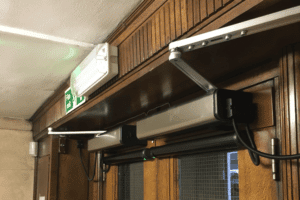
On-door Automatic Swing Door
If your door set does not have the space required to install an automatic swing door operator overhead, some companies can mount the operators on the doors themselves. Special considerations for space behind the doors in the open positions and power routing should be applied.
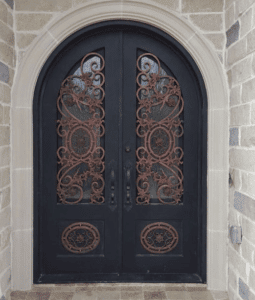
In-floor Automatic Swing Door
Exactly as described, the operator is installed below the floor surface and drives the door open by connecting to the lower door. Although these installations can be expensive they solve very specific problems such as minimalist designed glass entrances and arched swing doors.
Best use cases for Automatic Swing doors: offices, schools, healthcare settings

Automatic Sliding Doors
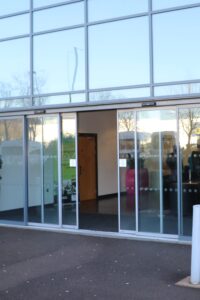
Overhead Automatic Sliding Door
This is the most commonly seen type of automatic sliding door. The operator is secured above the doors on the transom. The doors are then hung from the Operator and guided on the bottom by floor guides. Often seen with Aluminium and glass door leaf, these make up approx. 90% of the UK Automatic sliding door market. Used a lot for supermarkets and government buildings where a high volume of traffic may be.
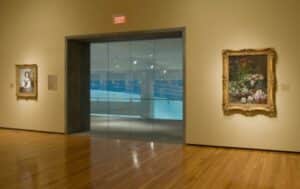
In-floor Linear Automatic Sliding Door
This operator is installed below the floor surface allowing for a minimalist design of building entrance. Although more expensive to install, this can give a cleaner automatic entrance design. The doors roll on the track below and are pulled by way of DC motor and connecting drive belt.
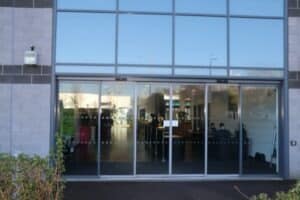
Telescopic Automatic Sliding Door
This is an overhead sliding door operator with multiple leaves. Commonly seen as 2 leaf single sliding or 4 leaf double sliding doors. This type of door allows for a greater clear opening on a sliding door installation.
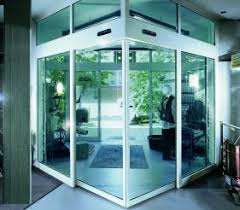
Prismatic Automatic Sliding Door
Rarely seen in the UK, these doors can be a showstopper. The automatic sliding door system closes to a point. Often seen as a 90-degree configuration on the very corner of a building. It makes for a very unusual and cool automatic entrance way. Also available as an in-floor automatic door.
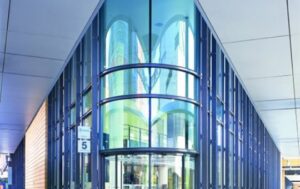
Curved Sliding Door
Utilising the same principles as the overhead automatic sliding doors; the doors, frame and operators are manufactured with a curve. These curved automatic sliding doors can offer a premium looking entrance to blend into your building design.

Oversize Automatic Sliding Door
Large offices and prestige buildings are often looking for a special welcome to their clients. Oversize doors are a specialist foray, but when done correctly can offer an incredibly different reception.
Doors have been installed as large as 6 metres tall in an automatic configuration.
Best use cases for Automatic Sliding doors: supermarkets, retail units, transport hubs
Automatic Bifold Doors

Automatic bifold doors are available in single or double. Two leaves fold in each direction to form an automatic opening. These doors are commonly seen when an automatic swing door cannot be used as the door swing would impede on another space or especially useful in windy locations.
Installed overhead, these faster action automatic folding doors can handle volumes of traffic quite comfortably.
Best Use cases for Automatic Folding doors: narrow entrances, corridors, restricted spaces
Automatic Revolving Doors
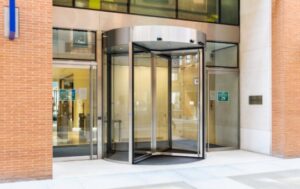
Automatic Revolving doors are often seen on large offices or buildings. Here are a few main benefits to automatic revolving doors:
- They are a very prestigious door entrance that entices a welcoming client
- They can keep the external air and noise outside – the door is never fully open to the elements, creating an airlock
- Energy Efficient – By keeping this barrier closed, whilst allowing ingress, the heating within the building remains
- To relieve stack effect pressure in buildings. High-rise buildings experience immense pressure caused by air rushing through the building
If you would like any more information or want to talk through the best type of automatic door for your building email us on sales@jmanny.com
*Photo credit: Record UK Direct